Poet’s Corner by Russell Bittner
Interview with Sally Cook
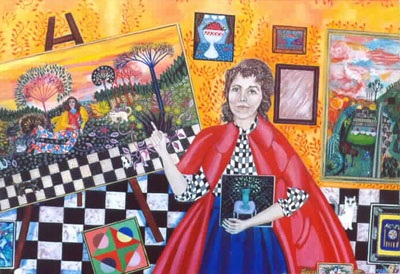
 Cover to Sally Cook’s collection of poetry “Measured by Song.” Artwork by the poet.
“God Gave A Crow A Piece Of Cheese; He Turned Around And Gave Me These”
November has always been—at least in my mind—a month of almost childlike anticipation. When I was a mere lad, November pointed to the homecoming of siblings who’d long since left the nest and were in college in some place unimaginably distant and beyond the reach of one mere lad’s compass. It also meant that we, with justification, could finally use the fireplace for its intended purpose. And finally, it meant that my mother would find cause to quietly sing—or at least hum—to herself in the kitchen while she prepared to feed a company of six kids and a husband. A husband, by the way, who’d be busy accompanying himself on the piano neither quietly nor humbly.
Those days are long past. My singing or humming parents are dead; my birth family is scattered around the country; my own abbreviated family signed on to our troubled times nine years ago and dissolved itself. I spent last November in a lonely little place called ‘Donner Summit’ in California’s Sierra Madre Mountains. This November, however, I’ve invited someone to join me and us here at the Summit—at least electronically—to share the holiday season. She’s Sally Cook—a poet whose work I first met many months ago through the pages of Trinacria.
“Differences” (in Issue No. 3; spring, 2010 of Trinacria, but also posted immediately here below) was not the first of Sally Cook’s poems I’d ever read. I was already well acquainted with her work from the last two issues of the same journal, and had often thought I should invite her to participate here at “Poet’s Corner.” Unfortunately, however—Brooklyn being full of distractions—I never got around to extending that invitation until I headed up the mountain out here in California, where I finally found some peace and quiet.
I read her four poems (“Differences,” “Change in the Weather,” “Beginnings” and “Berenice,”) several times over and decided she’d be an excellent candidate for an interview. I then e-mailed her. She answered the following day—and so, here we are.
As custom suggests, Sally deserves a formal introduction. She gets it here by way of her bio:
RRB:Sally, with your kind permission, I’d like to open with a quote of yours I found online in last year’s fall 2010 issue 3.2 of Think Journal and ask you to elaborate a bit upon it if you’re still feeling so inclined. To wit:
SC:I was speaking about the abandonment of those time-tested natural rules of tradition and good sense. Everyone knows what happens when the only rules are silly, untested, politically inspired top-of-the-head bureaucratic ones that make us grit our teeth in disbelief. Children go wild; we get indigestion; we crash through stoplights. But today we live largely by meaningless “rules.” This is especially clear in the arts.
Poets have unparalleled access to a magnificent historical progression of poetry, yet many choose not to use the tools at their disposal. The one “rule” they most use is the false one of tearing apart—then reconstructing—what went before.
Passing feelings, without a construct on which to hang them, are too ephemeral to live as poems. Though rules evolve, they do so slowly. No list put together by any poet of the past one hundred years can stand alone against the great traditions that we ignore.
So many frustrated poets go around acting like over-crowded chickens, venting their confusion by attacking each other. Too bad they aren’t taking advantage of the ease with which knowledge is now available to them—a wider perspective could only benefit their work.
RRB:In support of your observation, Sally, please allow me to quote Oscar Wilde: "All bad poetry springs from genuine feeling. To be natural is to be obvious, and to be obvious is to be inartistic."
With that behind us, let’s move right along to your first poem here: “Differences.” That I can see, no danger of sentimentality anywhere on the perimeter. Please give us some background to this piece.
SC:On surface, this poem is about a man and a woman in a restaurant, having a conversation. Each life is being questioned. No literal descriptions of these two are necessary. He is a black suit; she, a blue dress. That is sufficient—the stage is set.
The woman keeps the conversation on an intellectual plane. Something he says causes her to hear warning bells. The more he presses, the more she backs off, realizing that it’s all about him and his inability to resolve his own questions. She has been tested, knows her subject well and scores high. That’s the literal scenario.
This is not a report, it is a work of art called a poem. Oscar Wilde was right about art. To make art out of any situation, one must first thoroughly consider it, then select a form and rhyme scheme that will work for the subject. Then change the weakest elements to suit your intention.
Just as in a painting or a musical composition, tension must build. Whatever the medium, this is a situation in which a spotlight is being focused on the unsaid. This is a portrait in words of a conversation. Form and lines should mimic the terseness of the conversation -- characters are secondary. Adjectives create texture, the use of words creates color. What the voices are saying is far more important than the actual words which couch the meaning. What is unsaid is most important of all! Yet there must be clarity; no fudging around. All of this piques interest and keeps the reader interested.
“Differences”
Under the black assurance of your coat
Lie credit cards. You hope that you were right
To build your castle and its little moat
Against the time when you would come this night
In expiation, longing to be free
From chains you forged yourself, in other years.
The ruby bottle squats. We each have three.
You talk of other times and hovering fears.
I tell you of the winding path I took.
You say you built your castle with small choices.
Your hands reach out, but we discuss a book,
And tell of how we lost those other voices:
Your father who was never there, and mine,
Whose voice choked on the words that might have healed.
I wish my mother could be here to dine
In elegance she never knew. Concealed
In banter, our cross purposes explode;
The empty salon echoes with our dreams.
You might have been a prince; you are a toad
Who fantasizes mild erotic scenes.
My crab cakes come; filet mignon for you
(You’ve been deprived, and so deserve the best).
In the dim light, my dress defiant blue,
Our difference is I know this is a test.
RRB:Brava, bravìssima, Sally! I like both the piece and your explication de texte, by the way. And now, on to “Poem for a birthday.”
SC:This is almost a sonnet, and yet it isn’t. The poem finished itself at the end of twelve lines. In this poem, figurative aspects or tropes are more prominent than form.
I’ve always envisioned the year as being round—and mentally picture it that way when searching for a date. It isn’t much of a stretch to mentally add a little frosting on top (in January) to that image, as well as some birthday candles.
Tropes require a retinue of objects. Who can deny that birthdays do have a tendency to harden the heart? Since I’d already introduced candles, dripping wax does the job.
Unless we are thirteen-year-olds, we all want the vicious cycle of birthdays to stop. Yet birthdays are inexorable. Wishes don’t die, but they do close up. Each one takes some light with it. If we’ve accomplished anything at all, the older we get the less we regret.
"Poem for a Birthday"
Say that the year is round, and on its top
March lighted candles in concentric rows.
They drip their wax, which hardens on the heart
As birthdays pass, and most of us suppose
That all we ask is just some time to stop,
Re-group, remit the past, revere a rose.
A natal day is just the place you start
To win or lose, to plow through winter snows.
Over the curve the candles move, then drop
Down, as the winds of time bring to a close
Each sturdy, hopeful wish within the heart;
More light recedes, and all our aging shows.
RRB:Excellent, Sally!
And I see now coming up that you’ve found the sonnet form —Elizabethan/Shakespearean, if I’m not mistaken—to work well enough for you in this next piece.
SC:It may seem strange to choose this form to write about something as grim as our world. But no matter what any of us have suffered by its neglect, most of us still maintain an affection for it.
Certainly this is no love poem. I would say it is rather a paean to a kind of bravery. Every time our world “gets up,” things start grinding along, with very little love manifesting itself. If we are lucky, no major disasters intervene. If they do, the worst of them are somehow not those chosen by communications media that most affect us. It is the personal ones; the deaths, illnesses, failures, together with those ominous windowed envelopes that come in the mail that remind us we are still alive.
What do we know of the world? It is really a composite of all of us and in that respect must have a personality of sorts. For personification purposes, I imagine it as a big, grid-covered globular head with a goatee composed of Australia and the North Pole for a nightcap. Poor thing never gets a comfortable night’s sleep; its comforts are well worn, and, no matter how stridently we are lectured by all kinds of so-called “authorities,” no one really appears to give two hoots what happens to it.
Nevertheless, it does arise every day, scrapes together a little nourishment and bravely faces its future. Some may entertain a sincere concern, but to tell the truth it doesn’t have much hope for anything from any of us. Still, it soldiers on. If only for this reason it deserves some mark of recognition, such as this little song.
“The World Arises”
The world lies sleeping on a lumpy couch,
Wrapped in some well-used inconsistencies.
Lacking a fleeting kiss, a warming touch,
It dreams a vision of no rest, no ease,
Yet morning always comes. The world gets up,
Brushes the sands of reverie away,
Gulps down some coffee and a little sup,
Walks out to face the cold impassive day
As if its fears for that new day were gone.
Dark and monotonous, the tasks it faces
Have no good end, cannot assure bright dawn,
And but for brilliant shards, some streaks and traces,
Occasional assertions of the right,
Have no expectance of a coming light.
Originally published by Contemporary Sonnet
RRB:Followed immediately by “Making Music”—another superb piece!
SC:This poem is about knowledge and song—in this instance, song being more than just a tune, but signifying any artistic expression of joy and beauty.
An artist is a good example of any unimportant entity forced to endure extreme cold and indifference. Powerless to do more than to endure, artists wait through the bad times in anticipation of that brief "June" when they may play and sing once more.
Even though the cold always hovers on the horizon, and it’s difficult to even think of singing, the artist knows there will again be times when he may "tune his fiddle" to that "single, steady hum" of knowingness—or of universal God-given knowledge—and that he may once again perform. He’ll continue to do this even though his audience will ultimately be composed of a preponderance of unfeeling, slimy slugs.
“Making Music”
As a hard frost contracts your nose, and pain,
Sharp as white pepper, almost has a sound,
You hesitate to ever yield again
To coldness and indifference all around.
The singing insect’s home is cramped and small.
Its bed is hard beneath the crusted rime.
It sleeps, for there is nothing left at all
For it to sing about in this harsh time.
All contrast comes to add more to the sum
Of what we know exists beyond all sense.
We strain to hear that single, steady hum --
A knowingness explicit, faint and tense,
Akin to strings that tighten when you tune
Your fiddle to a song composed by bugs,
Leg against wing, who’ll play again in June
In concert to an audience of slugs.
Published by the Pennsylvania Review, December 2010
RRB:Sally, since the hour is getting late, let’s take a walk on the light side with two pieces (“If Only” and “Fruit in His Future”), then leave the remaining poems for those who are tempted to explore more of this poet’s work. What can you tell us about these next two poems?
SC:Adam ate an apple and gained temporal knowledge. Newton was bonked on the head by an apple, which inspired the laws of motion.
What is it with these apples? The concept of fruit influencing science is more than enough to make anyone chuckle. Just the thought of it kept scratching at the back of my mind and made me take a new look at Isaac Newton. Fruit seems to have found a permanent place in our history and, as such, deserves further consideration.
“What if?” questions also have their permanent place in speculation about the direction history might have taken. Books get written all the time about such stuff. Although they don’t usually take as humorous a turn as does my poem “Fruit In His Future,” I’d like to see more of this approach to the serious. To me, humor makes something alive, immediate and interesting as nothing else does.
This brings us to my poem “If Only.” Wearing a hearing aid, Beethoven might well have secured a nice living somewhere as a professor, married, and stopped writing sonatas altogether. Just positing the “If Only” question about notable artistic figures creates hilarious scenarios which demolish the asininity of those who nit-pick everything into the absurd.
“If Only”
If Henry James had been at all paternal,
Married and fathered little Jameses, what
Adventures might have spiced his daily journal
Instead of other people’s feelings. But
At least he didn’t starve within a garret
As that poor painter Vincent did for years
Without a bit of sirloin, or a carrot,
Or even a sharp blade to slice his ears.
Our Emily spent hours in contemplation,
And agonized about the great Unknown.
Some kids, the PTA, a station wagon
Would have ensured she’d never be alone.
Then there was Mozart, hounded by a chorus
Of those who told him “Trust! We know what’s right!”
Some penicillin might have saved him for us;
There could have been more music of the night.
So many artists turn out to be not as
Productive as they might have been, and fade—
Just think, we’d have a dozen more sonatas,
If Beethoven had worn a hearing aid!
Originally published by Trinacria
“Fruit in His Future”
(based on the life of Sir Isaac Newton)
Sir Isaac Newton had a bent
For legal things, so off he went
With countenance both fair and sunny,
To search out England’s funny money.
The laws of motion moved him to
The Royal Mint, where he would do
His best to find the funny stuff;
And presently, he’d found enough
To sentence every counterfeiter
To death exotic, and quite bitter;
By rope and also by the blade,
Yet from his goal he never strayed.
Tired, he lay ’neath apple branches—
A scientist, he took no chances
With too much stress; in sweet repose
He rested, took himself a doze,
Woke briefly as the gallows tree
Dropped down its crooks quite evenly,
Confirming what he thought he knew—
That gravity controlled them, too.
Sir Isaac watched the round, red sun
Descend; his work had just begun.
Then in his reverie, a sphere
Fell fast upon his noggin here.
Though only one small fruit bonked Ikie,
Shaking his entire psyche,
Rebooting his mentality;
It changed the world for you and me.
Enlightened, apple tree beneath,
His basic law he did bequeath
To us, because it bopped his brow!
Sir Isaac said “I don’t know how
I could have been so awfully dumb—
One Mackintosh—one cranium—
Deductive reasoning shows me
That I’ve discovered gravity!
How wise he’d been to sit beneath
That tree, and to his heirs bequeath
Pomona’s promise to guard fruit—
With gravity, he followed suit.
And now he knew that lowly fruits
Could show us universal truths!
Still, Newton, had he been aware,
Might better have napped in his chair.
For fruit which in the garden fell
Announced the wide, wide road to Hell
Through knowledge. It was Eve who bit,
Though she knew Adam wanted it.
First Prize winner, Gutenberg to Heisenberg category, Dr. Alfred Dorn’s 2007 World Order of Narrative and Formalist Poets Contest
“Battle of the Sexes, Revisited”
Rude, raucous boys threw my books from the bus
When I was young. My mother made me go
Walking the route the bus had taken us
To reach my house. I cried, and made a fuss.
My papers blew across a sodden field,
A deep and muddy ditch spit up my books
And I bent to the power all mothers wield,
No longer challenged adolescent looks.
Today an unknown rash or some malaise
Would keep me from such adolescent trysts.
The boys would lose their college funds, and craze.
We’d meet again at the psychiatrist’s.
Harassment suits eventually would be filed,
Scholarship money for the victim child.
Originally published by Contemporary Sonnet
RRB:Sally, I can’t thank you enough. It’s been a real pleasure!
And with that, I’ll say goodnight to you and to our readers.