Poet’s Corner by Russell Bittner
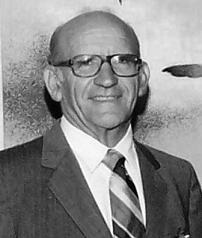
Interview with Ed Hujsak
May—or so they tell me—is Rocket Scientist Month. And so, who better to invite into our little corner than a rocket scientist. Finding a rocket scientist, by the way, was easy work. Finding one who also wrote poetry? I’d rather be challenged next time with looking for a needle in a haystack.
How, then, did I find Ed Hujsak? Through Your Daily Poem, where I also found “First Date”—just below. (You don’t really think I work to find these people, do you?)
Habits are not to be broken in May. And so, we introduce Ed with flowers and his bio:
RRB:First off, Ed, how does one survive as the ninth of twelve children—never mind get to be a rocket engineer? Growing up, did you often have to remind your parents of your name and place in the family? I, myself, am one of six—and I thought that was a zoo. But one of twelve?
EJH:It was rough, as growing up took place during the Great Depression. We were lucky to be living on a farm—so, unlike many, we didn't go hungry. An enduring memory of that time is that there weren't many obese people. There wasn't much parental supervision at home, as my father, who lived to be 100, worked all the time, while my mother died at 45 after the birth of her twelfth child. But discipline was good; we all helped each other; and we even managed to get through without any scars right up until WWII, when half the family enlisted.
RRB:That, Ed, is what I call both an enduring and an endearing memory—as is the dedication of fifty percent of you to the war effort! It sounds to me as if the Hujsak clan comprised the majority of a single battalion!
I know, Ed, that your wife died barely two months ago. Did you write this poem to her?
EJH:I wrote the poem at the kitchen table sometime around our fiftieth anniversary while Joy was cooking dinner. Last year I tossed it into a discussion panel on Goodreads.com and a curmudgeonly guy named Michael—a consummate critic and ardent Shakespearean loved it—but also offered a revision to my rather straightforward last line, which I liked a lot better. (She was really 26 when I phoned her.)
“First Date”
You said you were forty
when I first phoned you.
But I was lonely
and forty sounded
not so bad,
all things considered.
On our first date
I showed you rockets -
firing.
You were frightened
and dove for the shelter
of my arms.
Later we drove to Pat’s
for hot dogs and drinks,
and when I kissed you the first time,
ahhh! on boysenberry-wetted lips!
From Scattershot, A Collection of Unrelated Poems (Mina-Helwig, 2009).
RRB:Just out of curiosity, Ed, what was your original line?
EJH:The last two lines read "and I kissed you for the first time ..... on boysenberry-wetted lips." So actually the last two lines were changed. Michael made them sing.
RRB:You mean to tell me he added only “when” and “ahhh!” and you thought that little addition made them sing when your original composition didn’t? Sheesh!
Okay, let’s move on to “New World.” But please don’t tell me that your curmudgeonly Michael suggested you insert a comma or a period or—God help me—a double em dash that then made this poem also sing! Take a little credit for your own poetic talents.
EJH:Nevertheless, one word can make all the difference. In this case, it completely changes the mood. That may be why poets constantly revise. What sounds good one day is unacceptable the next, for reasons known only to the writer. But that's an engineer's observation, and there may be counter-arguments. I can't imagine writing a poem that sings from end to end. If one or two lines are good enough to lodge in someone's memory, that—to me—is sufficient achievement. (From “The Pact": "We watched while chicks/jack-hammered their way/into a world of which/they had no understanding.") You will never forget this.
RRB:Yes, Ed. I have to admit. That’s quite good. And I’m inclined to agree that it’s an image I’ll carry with me to my grave. I don’t know who wrote it, but it’s quite good.
Now tell us about “New World.”
EJH:New World is the result of depressed feelings about the wretched situation that is the lot of most of humanity, and addresses implicitly the fact that most of what is present is the product of men’s actions. Women were pretty much taken along for the ride. Men like wars, power, property, etc. and go to incredible lengths to acquire any or all of it. Men styled religion in such a way as to control what people can and can’t do. Women, on the other hand, are organizers—they have to be in order to bring up their families. It's in their nature. Yet they had little discernible role in shaping cultures around the world. So, the poem is just a dream about re-shaping things. The part about CERN, where the world's largest particle accelerator is located, is a bit of whimsy. They’re trying very hard to find Higg's boson, which might help explain everything.
“New World”
In these happy lands
rockets and submarines
lie buried at the bottom of the ocean.
Cathedrals and mosques
have been dismantled
to make homes for the weary.
Mecca and places like it
are archeological curiosities
in the desert sands.
The Vatican is preserved.
We have made it a museum
for false gods.
CERN is the center of our universe.
Higg’s boson (the God particle)
turned out to be the same as love.
The internet has brought
all people together.
Notions of class have been erased.
Evenings, when work is done,
poets read their works
to tell how things are.
Musicians arrive,
unpack their instruments
and everyone dances.
RRB:NEWS-FLASH! I just learned through the backdoor that
“We watched while chicks
jack-hammered their way
into a world of which
they had no understanding”
is Ed’s own creation. I, at least, oh, worthy readers, am impressed. Think about it for a moment. The vocabulary is one any fourth-grader would recognize and understand. Take the line-breaks away, and it’s a simple sentence. The imagery, however, is quite profound on at least three levels: (1) chicks do what they do with their beaks; (2) the jack-hammer does what it does by virtue of men’s hands (or, metaphorically, chicks’ beaks); (3) the world into which chicks or men diligently jack-hammer is one of which neither, fundamentally, has any understanding.
I don’t know about you, but I believe this may be the most profound stanza I’ve ever read here at “Poet’s Corner” in A Long Story Short.
Have I read more abstruse things? Sure. Have I read more lyrical things? Absolutely. But have I read more profound things? No.
Enough of this patting on the back. On to “Yearnings.” Ed, over to you.
EJH:“Yearnings" was a simple encounter with an unexpected, fleeting, natural wonder and wishing someone dear but distant was there to share it.
“Yearnings”
I wanted you to be there,
standing at the canyon’s rim
where manzanitas spilled
their evening scent.
The sun, high spirited,
winked when passing out of view,
reached for its palette
and painted a cottonball sky
in raging pinks.
You would have thought
you’d seen the glory,
been humbled into silence.
You would have sensed
the power of love.
RRB:You have a gift, Ed, for personification. That’s rare in a poet—even more rare, I’d imagine, in an engineer.
Now tell us, please, about “Urban Sprawl.”
EJH:“Urban Sprawl” is about the farm in Merrimack, New Hampshire where my siblings and I grew up. It was a beautiful place, surrounded by woods that contained ponds and a running brook. When my father died, the farm was sold to a developer, and is now covered with streets and houses. Of course, this isn’t unique. It has occurred countless times across America as the population burgeons. The setting for the poem is visiting the place with one of my many nieces and recounting what used to be. This poem took first place in the Merrimack Public Library's annual poetry contest in 2008. Another of my nieces read it, and that was kind of nice.
“Urban Sprawl”
The Hays place, where my father farmed
and raised a generation, is no more.
Signposts now spell Mallard Point.
Paved roads crisscross green acres.
New houses sprout on scattered lots.
That tree line borders wetlands,
where the slim Baboosic winds, pauses
at beaver dams, and seasonally creates
its own little islands. Birches that stood
wrist thick then, tower full bodied,
sullen as a horse standing in the rain.
Here is where the farmhouse stood,
long since bulldozed. That pile of rocks
was its foundation. And there the peg-
beamed barn. One day firemen came,
torched it, and burned it to the ground.
On this bare untended lot my mother’s
roses struggle to preserve her mark.
Tomorrow the backhoe will roar, blow
blue smoke and erase her memory.
There where the silos stood, we rambled
on a grassy slope, read porn comics
and smoked corn silk cigarettes
deftly rolled in catalog paper.
And behind that cedar house
stone walls enclosed a brick lined
well, capped with moss green planks.
Don’t you remember?
You picked wild raspberries there.
RRB:Not only a gift for personification, but a descriptive talent that exceeds that of most poets I’ve ever read. Were you not frustrated, Ed, spending all of those years and energy on engineering?
I know one has to earn a living and feed a family. I, myself, spent over twenty years in sales and marketing and hated almost every minute of it—except for the perqs, of course.
EJH:Being part of the development of rockets that took America into space was quite exciting. The desire to write was there but had to wait until engineering occupied a lesser part of my life.
The opening statement in my short book of poems, For Love of Trees, states: "I have this thing about trees, as I'm certain others do. It borders on reverence."
"Ebony" is one of a selection of trees around the world with which a conversation takes place—all related to their particular place in nature and in relation to humans. I'm not a tree hugger. Mature trees need to be harvested, or they’ll die—as all living things eventually do. But a seasonally renewed tree is a thing of wonder.
RRB:Ed, I couldn’t agree with you more! One of the first times I came out here to California, I rented a car and drove up to Sequoia National Park. We have our beautiful trees back East, no doubt, but nothing on God’s green planet (in my humble opinion) compares with the redwoods and sequoias of California.
“Ebony”
Think music.
Think keyboards.
Think Mozart, Pete Johnson,
fingers on satin smooth keys,
sounds of Cesar Franck roaring
through open church doors.
Think ornaments
in the dark sarcophagus
of an Egyptian princess,
black bangles on bronze arms
of Bantu women.
Think carvings of black idols,
pachyderms and primates,
warm to the touch
from sucking up the sun.
You can’t hear it
amidst the rustle of leaves,
but deep inside me
a black heart leaps
at the thought of you.
RRB:And from the splendor of tall trees, we move on to the elegances of roses.
EJH:There must be thousands of poems about roses. But sometimes, at an unexpected moment, you come across something so elegantly beautiful you can't help casting a net of words around it. In this case it happened to be a rose that shed its petals overnight.
“The Rose”
Hello beautiful.
Such a surprise,
finding you this morning,
naked in crystal,
surrounded by crimson petals.
You did your part flawlessly,
sharing your ineffable, scented self.
You were really a bundle of tears,
weren’t you?
Tell me you wept out of loneliness,
and not for humanity, because
our struggle is beyond your care,
and we’ve not yet found our way.
RRB:Exquisite, Ed. Simply exquisite! And “Day 31,046”?
EJH:This poem was written on my 85th birthday (Those driven to check my math may have forgotten twenty-one leap years!) It dwells a little on the realization that life for folks in their countdown years can be pretty dreary. On the other hand, if you’re lucky enough to keep someone young around, most—if not all—complaints are easily rationalized. My thoughts are that the attraction of an "empty nest" home, i. e. "Freedom!" has its own set of drawbacks. And maybe the old idea of two or three generations in the same household was the best. When my father faced the prospect of lonely years in the big farmhouse, children and grandchildren who needed a spot to land for a while moved in and out. So his problem was solved nicely.
“DAY 31,046”
Seated beneath the showerhead,
massaging arthritic knees,
I ponder this day’s happenings,
try to remember whether
anything of note occurred.
I woke to sounds of
snarling chainsaws,
howling wood chippers,
ceaseless sizzle of tire treads
on asphalt and concrete.
Weighed calamaties
against blessings.
Gave thanks to great unknowns,
that skeptic sliver of me
still agnostically comfortable.
Brewed Chemex coffee,
ground in Kitchen Aid’s mill,
years older than I.
They don’t make things durable anymore.
(Rapid obsolescence drives the economy).
Combed three stores in search of
Zweiback, Stimudents, Pastilles.
No longer shelved, I learned.
Shopping carts, so convenient,
do double duty as walkers.
After noon, physics biased grandson,
tail-ending a two-miler, jogged in.
Asked for bread and water.
A good sign-
already attuned to simple needs.
To stoke his fires
I dwelt on fusion power,
averring tokamak is dead,
ITER classically an exercise
in policy gone mad.
I told him fusion power
is simple, explaining how.
We spoke of thousand-year
power plants, and turbines
spinning over countless suns.
Shower’s beginning to turn cold.
Taking stock, though healing,
now leads nowhere.
Still, I wonder how this day
will shape tomorrow.
RRB:Ed, we’re not coming to the end of our interview. It’s been more enjoyable (for me at least) than you can imagine. Take us out with “Storm Watch,” if you will.
EJH:A person could feel guilty writing a poem like this. The words literally fall into your lap. It was written as the whole event took place, over a period of a couple of hours. No changes.
“Storm Watch”
It takes patience
but time not ill-spent
to view a brewing storm.
Alone, no sign of humans
or their contrivances.
Slight wisps of vapors form,
fade and reappear to coalesce
as robust cloudlets
that merge and transform
magically in an unseen world
of swirling air currents.
Images appear, cosmic mimes,
like actors at their own party.
A camel skates across the sky
chased by an improbable dust storm.
A cathedral rises, then scatters
like fireworks in slow motion.
A white panther creeps
along a silvery parapet,
then slips below
emerging shark’s teeth.
A mushroom cloud erupts,
a smokey stem with an
illuminated crown.
A reminder to never forget
Hiroshima.
Dark clouds follow
that shut out the sun.
Trees tremble and sway,
dancing with the wind.
The air feels charged
in a sudden stillness.
as the first lightning bolt
splits the sky.
A thunderclap
sends me running,
already drenched by
pelting raindrops.
RRB:What can I say, Ed? The piece leaves me speechless.
And so, I’ll say no more than “Goodnight” to you and to our readers—and “thank you” to you and them as well.
Photo Credit: General Dynamics