Poet’s Corner by Russell Bittner
Interview with Wendy Morton
May is the merry month of maenads (the Bacchae or Bacchantes in Roman mythology), the followers of Dionysus (in Rom. myth.: Bacchus). The maenads were allegedly guilty of many things that would put a Harpy to shame – so we frankly don’t want to talk about them here, except to say that among them was a sexual fervor that would make even a present-day Lady Gaga or an erstwhile Madonna blush!
Wendy Morton, however, is no maenad – although some of her poetry would suggest that she might‘ve been one at some point. I first came across an example of Wendy’s poetry at Your Daily Poem. (If you don’t already know the Website, I highly recommend it for your reading pleasure. A poem a day may not keep the doctor away, but it’ll do wonders for whatever communing you do with Calliope.) I read “If I Had a Name Like ‘Rosie Fernandez’” and was hooked. However, finding Wendy up in the wilds of Canada–even by e-mail – was another story. Lucky for me, I found the “Random Acts of Poetry” blogsite and, within the hour, Wendy responded with a telephone number. (Canadians are obviously a tad more trustful than we Yanks.)
As always, and before we begin, here is Wendy’s bio:
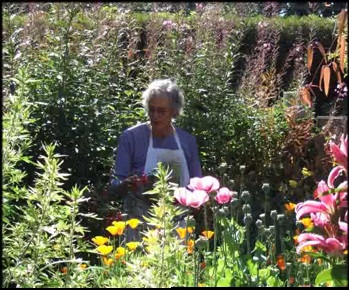
Photo credit: Rod Punnett
RRB: If it’s okay by you, Wendy, let’s start with a toast to the piece I read at Your Daily Poem: “If I Had a Name Like Rosie Fernandez.” And if it’s also okay by you, we’ll make that toast with a glass of Southbrook Vineyards’s Cabernet Merlot in honor of your entrepreneurial achievement.
WFM:Thank you for the toast, Russell. This poem has such an interesting story to it! One day, years ago, I got a call from Rosie Fernandez – a producer with the Canadian Broadcast System. She wanted to set up an interview as a podcast. I was delighted! And then I said “If I had a name like yours, my life would have been entirely different.” And I wrote the poem.
At about the same time, the University of Toronto contacted me to include me in their Canadian Poets website, and I sent them some poems – including this one. A couple of years passed, and one day I got an e-mail from Laura Wills, a graphic designer in Toronto, who said she was designing labels for a small winery called Southbrook Vineyards. They were going to have a Poetica series; she’d found the website and had fallen in love with the poem. I’m now one of the few “wine label poets” in Canada. The label was recently chosen to be in a book titled Contemporary Wine Labels, published by Santa Monica Press.
If I Had a Name Like Rosie Fernandez
I would wear gardenias and orchids
in my hair.
I would buy some hot sauce
called “Jump up and kiss me.”
I would offer it to strangers.
If I had a name like Rosie Fernandez,
I would know how to tango,
I would tap dance on sidewalks.
I would fall in love insistently,
spend hours in cafes
with a broken heart
and good coffee.
Oh, if I had a name like Rosie Fernandez,
I would know it.
from Gumshoe, Black Moss Press
RRB:It’s truly a gem, Wendy! And I love that something as simple as a person’s name can spontaneously give rise to a poem.
I’ll be honest with you, however. It wasn’t just the spring in the words and the extraordinary visual image you paint with them that caught my attention in this piece….
My college-aged son has been wrestling these last few months with something I dare say the vast majority of men wrestle with, and to which Eduard von Bauernfeld, a Viennese dramatist, first (so far as I know) posed the unanswerable question that Sigmund Freud made famous a short while later: “Was will ein Weib?” (“What does a woman want?”)
Now, Wendy, I hate to generalize from any single instance, no matter how nifty the illustration. So, the men reading this interview shouldn’t conclude that you’ve now provided us with any answer but your own – or maybe not even your own…maybe just the answer your imaginary character, Rosie Fernandez, has given.
Before we move on to your next poem, ‘Love Isn’t,’ perhaps you’d like to take a stab at answering what I’ll farcically call “the manly bane and the woman’s gain.”
WFM:No one has ever asked me that before. Here’s what I think – andI think Rosie would agree.
What does a woman want?
Someone who sees her as lovely
Someone who sees her as intelligent
Someone who can help her when she needs it
Someone who can make her laugh
Someone who is completely reliable
Someone who is as smart as she is.
The love issue, by the way, is handled in my next poem
RRB:Mind if I run this by Lady Gaga just to confirm?
Okay, then. Let’s not waste time and words – but instead get right on to what love is (or isn’t, as the case may be).
Love Isn’t
thunder and cinnamon.
Is walls the colour of Provence;
seagulls framed in the skylight,
between clouds and the morning moon;
hoya trailing night perfume;
a level floor;
a new sink;
your hands.
from Gumshoe, Black Moss Press
Care to give us a bit of background to this one, Wendy? A kind of explication des textes from an insider’s perspective?
WFM:I wrote ‘Love Isn’t’ for my partner as a birthday present. One of the great things about being a poet is that the gift of a poem is the best gift, from my perspective, whether or not I write it or it is a gift to me. I just celebrated a major birthday and was presented with a tree filled with poems written for me.
I’m not a big believer in that “falling-in-love” state – which I have been in at various times in my life. I distrust it. Distrust the “thunder and cinnamon” because it doesn’t last, at least in my experience. Rather, I’ll take someone who has painted the walls, built skylights, transplanted the hoya, made the floors of this eighty-year-old house level. Someone who has put in a new sink – all for love. How could I resist?
RRB:Hmmm. Sounds as if you’ve soured a bit on Romeo and Juliette, but that’s quite understandable. At our age and station in life, thunder and lightening are best left outside out among the other savage elements.
Set up the next three poems for us if you would please, Wendy.
WFM:‘Falling Water Birds’ is one of those ‘just grab the moment’ poems. It didn’t take long to write it. I went outside, heard the red-winged blackbirds, and wrote the poem. Like falling water.
‘Grandma Dancing’ was also written quickly. I was at a poetry retreat that I organize twice a year for Patrick Lane, one of Canada’s greatest poets. I was about to serve lunch, and I reached for my grandmother’s soup ladle – and the poem just flooded in. She’d been gone for years, but the image of her touching her toes at sixty-five started the poem. And I do carry her in my apron pocket, still. As well as many other ghosts.
‘At The Crocodile Café’ was written – but of course – at The Crocodile Café. I was in the interior of British Columbia looking for a place to eat and saw their sign. It said: “The best place to eat in the valley, no smoking.” I went in and found two regulars present. I listened to them and wrote down some of the things they were saying. This is more or less an eavesdropping poem – with poetic embellishments.
Falling Water Birds
The red winged blackbirds
arrive each year
in the trees behind the house.
I call them
the falling water birds.
There is a stillness my mind remembers.
Not the sound of birds.
Waterfalls. Cascades of light.
What are the sounds the mind makes?
Falling water. Blackbirds.
from Private Eye, Ekstasis Editions
Grandma Dancing
When Grandma was sixty-five
she could touch her toes,
bending from the waist.
And dance, hairpins flying;
a gypsy under the burning moon.
Then she’d pour herself a sherry,
put her apron on,
and make a steaming dish of chicken paprikash.
Grandma, I carry you in my apron pocket.
I make your lentil soup:
eggplant, apricots, a little cinnamon to taste.
Grandma, I know your steaming Hungarian ghost
burns in me: the cook, the dancer, dancing,
bending from the waist.
from Gumshoe, Black Moss Press
At the Crocodile Café
The regulars at the Crocodile Café
talk politics, hummingbirds.
They decide that politicians
fly blindly into lies:
birds make more sense, they say,
and the talk turns to purple martins,
indigo buntings,
and the ruby-throated hummingbird.
Now there’s a bird that’s got some sense, one says,
“Last year I had 32 perching
on my shoulders, arms and hand;
all waiting for the feeder to fill.
I was their bridge between the earth and sky.”
The other said he planted
wild columbine, bee balm,
coral honeysuckle and phlox
to keep them all around.
And how they swam in the air
when he watered, swept into the mist
like small swimming rainbows, singing.
Jewels, he said,
humming jewels. Rubies.
from Undercover, Ekstasis Editions
RRB:And these poems, Wendy, are jewels! I suspect they’ll serve as inspiration to our readers (many of whom are, themselves, poets) to try looking at everyday things from a “Wendy Morton prospective.” After all, not every poem has to be a loud celebration or a quiet lament. Sometimes it’s enough just to sit, contemplate the lint in one’s own navel, then describe it (with or without embellishment).
We’ve got four pieces left. Would you care to give us some background to these as well?
WFM:I‘d be happy to.
‘What Lasts?’ occurred to me when I read an article in the paper about the 550-year-old man whose body had been found in glacial ice. That started me thinking about what parts of us would survive in ice. And then I began to imagine who he was. After I’d written the poem, he became very real to me.
For six years, I was WestJet Airline’s “Poet of the Skies.” I’d read one of my poems to the passengers and then write poems for any of them that wanted one – all of this in exchange for free flights. I wrote “Clare’s Heart” for Clare Laking, who was then 105. His grandson told me about him. Later, I was told that Clare had put the poem up in his room at the Veteran’s home where he lived and had invited everyone to read it. He was very proud of it. About a year after I’d written it, I heard that Clare had died. He was one of the last surviving soldiers of WWI. I was glad I’d had a chance to honor him with my poem.
A childhood friend of mine came to visit. We spent the day together and retrieved old memories, some of which I’d long since forgotten. She called her cousin to confirm that “the mannequin’s ketchup-bloodied arm” was real – and that we’d really been bad girls.
‘For the Planet’ is a pantoum: I like to call it ‘a poem by numbers.’ I wrote the first ten lines after hearing from a friend about his daughter’s school presentation, which she’d given in French. I then put the lines into a specific order of five, four-line stanzas: 1 2 3 4/2 5 4 6/5 7 6 8/7 9 8 10/9 3 10 1. There’s a kind of magic that happens once the poem is done, and the beauty is found in the repetition of the lines. I read it as one of my “ 10 greatest hits” at my birthday poetry reading and a woman in the audience came up to me afterwards and said, “ I am on the sill of my life,” and hugged me. Oh, the power of poetry.
What Lasts?
(The well-preserved remains of a 550-year-old man
are to be cremated…thrown to the wind.)
Not the new moon in your mouth:
not songs
or the geometry of dreams.
In ice;
thorax,
spinal cord.
chest wall,
throat, pollen from high alpine alder,
knives, sticks,
coats of fur.
What of the frozen heart,
Locked in glacial ice?
Or the mind, the hands?
He lasted, this man in a woven hat;
perhaps a singer on the wind,
holding the blue moon
in his open mouth;
watching the starry geometry
of his frozen dreams.
from Undercover, Ekstasis Editions
Clare’s Heart
(for Clare Laking, age: 105)
is made of trout fishing
on Drag Lake with the backwood boys;
is made of the sound of his skates
on the pond’s blue ice;
and the three centuries he’s seen pass:
the world that has changed
and broken and changed again;
is made of the red dreams
of horses; the dark gardens of war;
his Helen’s gardens of heliotrope,
hyacinth, mimosa;
all the silver ghosts that listen for their names;
his golden letters from the Queen;
is made of hockey nights on the CBC
with a couple of Molson lites.
This battered palette.
Clare’s heart.
from Undercover, Ekstasis Editions
Bad Girls
My old friend shells broad beans
from my garden,
calls the fava.
French? she asks, Italian?
It doesn’t matter, I say,
if you’ve got garlic and basil.
We’ve spent the afternoon
at Otter Point,
watching the comfortable fog sweep in.
She reminds me
of our halcyon days
when we dangled a mannequin’s
ketchup bloodied arm from the trunk of the Studebaker,
drove to gas stations,
asked, “ Where’s the river?”
Or when we dropped iced cubes
from the 10th floor
of that Florida hotel,
then hid under the bed.
Oh, we were bad girls then.
And now, in the time between
middle and old,
we’re still bad girls,
looking for the river,
waiting for the fog.
from Shadowcatcher, Ekstasis Editions
For the Planet
A girl is alone on the stage.
She is on the sill of her life.
She is on the sill of the planet.
If she could, she would be a forest.
She is on the sill of her life.
She would be balsam, pine, hemlock, fir.
If she could, she would be a forest.
She would be eucalyptus.
She would be balsam, pine, hemlock, fir.
She would exhale oxygen.
She would be eucalyptus.
She is speaking French. It is not her language.
She would exhale oxygen.
“Tu pense que tu vole comme un oiseau.”
She is speaking French. It is not her language.
She is speaking in treesong, birdcall.
“Tu pense que tu vole comme un oiseau.”
She is on the sill of the planet.
She is speaking in treesong, birdcall.
A girl is alone on the stage.
from Gumshoe, Black Moss Press