Poet’s Corner by Russell Bittner
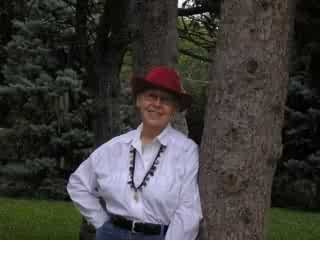
Interview with Marilyn Coffey
 July is a time for fireworks and full-fledged shenanigans.
Marilyn Coffey, however, ain’t no shenanigans. Fireworks she may well be, but of shenanigans, nada! So lay your gun down, cowboy; listen up to a bit of fireworks verse; and put your mind and britches at ease. When Marilyn comes a-callin’, you can keep your britches on; it’s only your mind she’s interested in -- and that you can let go free.
As always, and before we begin, let’s pay Marilyn the courtesy of a gander at her bio. Forgive the length of it; she’s been a busy girl:
RRB: Whew! Let’s not allow Sarah Palin to get a look at this résumé, Marilyn. She might just put her tail between her legs and slink on back to her beloved tundra.
We could spend the whole session dissecting this resume and asking you for details. However, tempus fugit. If you’ll allow -- just before we take a look at some of your poetry -- I’d like to ask you to give us (or at least me) some information on Mail-Order Kid: An Orphan Train Rider’s Story and the “orphan train movement.” I must confess, I’d never heard of it until just now.
MJC:The “Orphan Train movement” is amazing! For seventy-five years, hundreds of thousands of orphans and other homeless children were torn from their East Coast cities of birth, plunked into trains, and placed with rural strangers.
Protestant orphanages found families for their children by newspaper advertise-ments; Catholics relied on help from the parish priests.
No one knows exactly how many children the orphanages (mostly in New York City) displaced from 1854 to 1929. The latest research indicates between 400,000 and 500,000 children may have been shipped to nearly every state.
Some farmers took children -- especially young boys -- to work as cheap labor. Sometimes children, like Teresa Martin (the subject of my biography Mail-Order Kid), were abused: sexually, physically and/or emotionally. Other boys or girls were taken by people who really wanted a child to raise; those children were treated kindly and often well-educated. Most families, though, simply tolerated the children so they could be put to work.
The founder of the movement, Charles Loring Brace, sent boys to farm families to get them off New York City streets. In 1854, about 30,000 children had no home but the city’s cement. Immigration was at a peak, and thousands of families came to New York expecting to find streets paved with gold. What they found was a dearth of jobs and housing. They were crammed seventeen or more to a room. Some turned to alcohol and sent their children out into the streets to beg for them. Others died from contagious diseases that fouled their tight quarters.
The “Orphan Train movement” ended when states charged orphanages steep taxes for bringing in children, or passed laws forbidding such importation. Critics called the movement a thinly disguised form of slavery. Social workers questioned the wisdom of uprooting children from their cities of birth. Gradually the “Orphan Train movement” morphed into the foster care system we know today.
RRB:That, Marilyn, is a gruesome tale -- gruesome in its own way as the Trail of Tears I first learned about only a few years ago. I grant you, I was never an American History buff. But I certainly would’ve remembered both unhappy facts of American history if they’d been taught to us.
Now, I hate to appear callous, Marilyn, but tempus… and all that. Let’s look, if we may, at the first poem we’ve selected for this interview -- and, by no small coincidence, the one that has netted you the most fame and fortune to date: “Pricksong.” Give us a bit of background, if you will, to this hilarious piece.
MJC:When I was still a fairly new poet, I read Edward Field’s Stand Up, Friend, With Me. I loved his poetry -- such energy, such humor. Soon, I wrote poem after poem remarkably similar to his. At the height of that period, “Pricksong” flew into my mind. I copied it down, word for word, just as I heard it. Unlike my other poems, it needed no revision. But the poem lacked a title. Try as I might, I could think of none. Finally I stole a word from Robert Coover’s collection of short stories, Pricksongs and Descants. Those are musical terms. Musicians “prick” the paper with dots or points to notate pricksongs.
I submitted my poem to a feminist journal, Aphra, where it was published. Then I forgot about it until the writer Erika Duncan, a co-founder with me of the Woman’s Salon, spotted me on the streets of New York.
“Where have you been?” she cried, running toward me. “We’ve been looking all over for you!”
I’d just won the Pushcart Prize, and no one knew how to reach me. (Those were pre-Google days.) Later that evening, I celebrated my good fortune with other Pushcart Prize winners, all packed into a small room, elbowing for space and holding their plastic glasses high.
“Pricksong”
I am cursed
by a large penis
which I planted in a flower pot
in my living room.
When it grew, like a cactus,
it looked thirsty and,
being kindly at heart,
I allayed its thirst
with water. It sprouted wings.
Now it flies around the house
and sings at me.
Once I tried to shoot it down
but horrified, it shriveled up
into a ball, retracting everything
it had ever said to me. What
could I do? I didn't have the heart
to follow through. Now it tries to get
in bed with me. I am afraid.
It is so big. It looks so thirsty.
It is never satisfied. Last night
when I pushed it back, it cried.
APHRA, a feminist magazine, first published it in 1975.
THE PUSHCART PRIZE: BEST OF THE SMALL PRESSES, reprinted "Pricksong" in 1976, a national prize.
1980s, Omega Cottonwood Press published it twice, once as a broadside and again in a collection of broadsides.
The International Parnassians Guild in India chose Pricksong for an anthology, PARNASSUS OF WORLD POETS, in 1994.
Next appearing in NEBRASKA PRESENCE Backwaters Press, Omaha, 2007.
RRB:An absolutely delightful anecdote, Marilyn, and a reminder to our readers that yes, the Muse can strike at any time, under any circumstances, and lead one by the hand and by the pen right to the page. It’s just a question of being prepared -- and receptive.
Tell us about “White Magic,” please.
MJC:“White Magic” is a favorite poem of mine, partly because it’s so personal. It describes a real winter walk I took down an old road that runs south out of Alma, Nebraska. The road used to be a highway to Kansas, crossing the Republican River with a bridge, but now the pavement disappears into the Harlan County Lake.
I grew up in Alma, close enough to the Republican River to play there. When I was in high school, I watched the U.S. Army Corp of Engineers dam the waterway about ten miles upstream and create Nebraska’s second largest lake.
The winter that I wrote “White Magic,” I had returned to Alma after thirty years’ living in New York City, so I saw the lake, transformed as it was by snow, with fresh eyes.
“White Magic”
Virgin the road, veiled with feathery snow
& still, but for my boots crunch-crunching.
Chalk white the beach, curled right & left
a huge snow-swollen quarter-moon, mute as night.
Frozen the lake, its whitecaps fused
into a milky disc, no wet splashes heard.
Overhead a whitewashed sky, bleached of dusk
by an ivory wand. I stop. No sound. None.
From habit I stare at the horizon now gone,
watch silvery dusk throb the creamy sky-lake.
Is Alaska like this, white on white on white
until one's eyes spin patterns on the blank slate?
Behind me I hear a familiar sound: geese honk
honking in near-unison. Their cries split
the silence: I squint, I stare.
I distinctly hear geese, but they're not there.
I start to walk back when the first shapes appear:
wriggling black silhouettes in slender strands
like ribbon streamers from a wedding veil.
Soprano, they call, and the answering flock,
alto, tardily shimmers into sight.
And the cold snow sky & the frozen milk lake
& the chalk white beach & the feather-strewn road
are cracked by black strings of geese flying by
by geese & the boot tracks I follow back.
Published by The Nebraska Humanist, March 1991
RRB:Damn that U. S. Army Corp of Engineers and their damming ways! I’ve got a nephew in the same Corp. I’m going to send him a damning/damming e-mail right this moment!
Meanwhile, however, let’s introduce your next piece: “Words Written in Water.”
MJC:Since, I assume, our audience consists of many writers, I chose this “writerly” poem.
RRB:Very funny, Marilyn. So tell me, what makes this poem “writerly?”
MJC:“Words Written on Water” shows readers my playful side. It was written in Woodstock, NY, a small town in the Catskills that did not host the famous Woodstock Festival. The festival was held on a farm near Bethel, NY. Bethel is forty-three miles away from the town of Woodstock where I often summered. That’s where I saw the pond, dragonflies, and jet stream in this poem I didn’t write.
Don’t ask me how the name “Woodstock” got tangled with that Aquarian Exposition on the dairy farm. Maybe the proximity. Or maybe Joni Mitchell’s song, “Woodstock” which she wrote in a hotel room in New York, never having been to the Woodstock Festival. Like nearly everyone else in the world, she’d heard about it. It’s still called “the most popular music event in history.”
“Words Written in Water”
Standing by the side of the pond
I composed a poem in my mind.
In it, two dragonflies flew
one above, one below the surface of the water.
In it, trees rippled upside down
and a jet stream not visible in the sky
crossed the deep eye of the pool.
In it, a caterpillar struggled toward shore
writhing in water.
But I couldn't think how to end this poem
so I didn't write it.
RRB:And “My Lion-headed Lover?”
MJC:I’ve been writing love poems most of my life. You could say it’s a passion of mine. I’ve collected about forty of them plus some anti-war poems in a book I call Pricksongs: Poems from the Sixties.
But this poem, “My Lion-headed Lover,” is a more recent poem, based on my current relationship with Jack Loscutoff. Jack is a writer, too, having published a sci-fi novel, The Cloud of Doom. He’s also a playwright, a cartoonist, and a poet, but the characteristic that most singularly marks him is his adoration of words. His mind is like a dictionary full of meanings, etymologies, and metaphors. You’ll see that in the poem.
“My Lion-headed Lover”
never stops wooing me
He rises from eager ardor
to relish the beauty of my spine's arc
with a blunt straight-nailed finger
that signals his constant rapture
His potent arms hourly encircle me
"hello" "good-by" "whatcha doing?"
as he pulls me into his powerful embrace
Almost as often as breathing
he declares his devotion
in multi-syllabic Latin-based words
cascading from his wine-red lips
as he celebrates cerebration
parses his passion for me
his English intimate in my ear
Even at night, asleep, my lover's
body reaches, stretches, turns
toward me. Magnetized
by thinly veiled veneration,
his warmth constantly seeks mine
as incapable of separating
as the sea is powerless
to ignore a rising moon.
RRB:Marilyn, it’s been more than a pleasure. It’s been an honor. Thank you very, very much.
Goodnight to you, and goodnight to our readers.
Coffey’s poem, "Pricksong," won a national Pushcart Prize in 1976. The Los Angeles Times Book Review called it "a wry poem about an obscene houseplant." Newsweek called it "surreal." “Pricksong” was reprinted in New York, Nebraska, and India.
Coffey's novel Marcella, which made literary history, was the first novel written in English to use female autoeroticism as a main theme. Gloria Steinem called it "an important part of the truth telling by and for women." Quartet in London published it in paperback; Pol in Australia and Ms. excerpted it, and Danish newspapers serialized it.
In 1989, Coffey's popular memoir, Great Plains Patchwork, appeared. The New York Times called it entertaining and insightful. Atlantic Monthly featured a chapter, “Badlands Revisited,” as its cover. Natural History bought two chapters, American Heritage one. Harper & Row, McGraw-Hill, Macmillan, and Harcourt Brace Jovanovich printed excerpts.
A trained journalist (B.A., University of Nebraska, 1959) and creative writer (M.F.A., Brooklyn College, 1981), Coffey is also an interpretive reader. She has taken part in radio shows in six cities, from New York City to Houston; been on TV twice in Nebraska and once in Woodstock, NY, and appeared personally before more than 130 groups in twelve states, from Maine to Texas.
Known as a prose stylist, Coffey received a Master Alumnus award for distinction in the field of writing from the University of Nebraska in 1977. Since 1987, the University of Nebraska Library Archives has collected her papers.
Coffey is an Admiral in the Great Navy of Nebraska, the state's highest honor. However, the honorary title is given in jest, since Admirals in landlocked Nebraska claim jurisdiction over few but tadpoles. Governor J. James Exon appointed Coffey, a Nebraska native, an Admiral in 1977 for her writing achievements.
Now retired, Coffey taught writing at Boston University, Pratt Institute in Brooklyn, and Fort Hays State University in Kansas for thirty-four years, twice earning tenure.
Marilyn June Coffey 4664 Frederick St., Omaha, NE 68106 Phone: (402) 455-4974
N. B. The University of Nebraska named her a ‘Master Alumnus’ in Writing for 1977. Pace the University of Nebraska: this woman ain’t no alumnus; she’s solid alumna.