POEM OF THE YEAR 2011 INTERVIEW
The editors of Long Story Short are proud to announce that “MY PRECIOUS SON” by Joseph Wade has been selected the LSS Poem of the Year.
Congratulations, Joseph!
MY PRECIOUS SON (For Ethan)
by JOSEPH WADE
Shadows stretch under the doorway
where light gave way to night.
into this split world,
into my arms,
my precious son.
your charm enchants me.
You laid on your stomach,
on the doctor’s cold, white table,
and simply lifted your infant head.
My chest swelled like a great ocean wave,
it was so simple, so magnificent.
Da-da-da-da-da-da-
You bopped and giggled
When you said it. You clapped your hands
and smiled, just at me,
that big, open, toothless grin,
stuffed between two fat baby cheeks.
She left us like a thief running after shadows,
I fell and slid down the wall, along with my sobs, my tears, and my fears.
what would become of you,
your crib, your home, your little white dog?
The scribbled picture of Mommy, Daddy, and Ethan,
disappeared in shadows,
held by the laughing, bony hand of fate.
Months later, she stole you away
and stood on a wall of justice.
She sat in the lady’s lap,
and toyed with the scales,
while she whispered in her ears.
Our last week together, we played in the sand.
I held you by your arms as the waves crashed.
You laughed brilliantly—like the sun
sparkling off rapid green waves.
We argued. You said, “up,” but you meant down.
You meant, “Let me crash with them.”
Okay, I let you think you are a big boy.
My arms encircled you like angel’s wings.
The wave came, massive to you,
not to me—but yes—to me.
Panic crashed as the wave came,
but I caught you.
I paused.
You laughed against my beating chest and flailed in delight.
Then we chased birds and threw sand.
We had dinner out with the guys,
just men being men.
I was suddenly free from the military, no job here.
A promise was 1,200 miles away.
Money for the scales of justice.
Those papers weigh so much.
She promised me summers and holidays.
Summer came with steam from hell.
Oh, how I longed for you.
My soul ached and flamed.
I came to find a judge’s gavel
could build a magic wall of nothing
and everything.
My strength shattered against it.
Chains wrapped around my ankles,
and they fastened a big heavy ball.
They bled me.
They made me weak.
My beating, bloody, red heart was torn to pieces
By pointed shadows lunging from all directions.
I see your face and cry. I know it’s changed so.
Your toddler steps are buried in sand.
I still hear you laughing through the
whirlwind, spun by the clock’s hands.
My heart is stitched together like a Frankenstein.
Now, I have all the green sheets with time
Written in block—black and bold.
I will place them all on the scales.
God! Please break them!
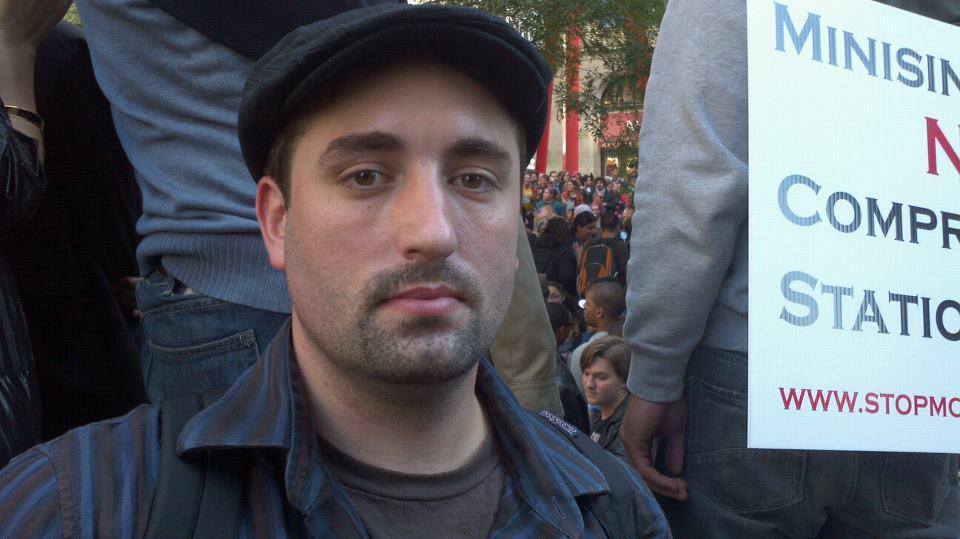
JOSEPH WADE studied under various professors at Harrisburg Area Community College. He is indebted to these people who have given so much more than what they were paid for, and like his family, loved ones and friends, have been highly supportive. Currently, he takes classes at Brooklyn College where he studies Creative Writing in the Scholars Program. Joseph’s writing background includes publication in prose, news and poetry. His most recent poetry publication was in the November issue of “Gloom Cupboard” and he has poetry forthcoming in Grey Sparrow Journal and Blue Lake Review. More information can be found at www.Josephwade.com.
Congratulations to Joseph who will receive a $25 prize in honor of former Poetry Editor, Sue Scott, and congratulations to all of the "Poets of the Month" for your fine work. We look forward to reading your poems in the New Year!
Wishing you a happy, healthy and creatively inspired 2012, Amy S. Pacini, LSS Poetry Editor
Please tell us more about you, Joseph!
INTERVIEW WITH JOSEPH WADE
Q. Please tell us a little about yourself
A little about me—why does this interview feel like a first date? Well, if you’re interested—I can say that I grew from the nerd who read books in bleachers at his sisters’ basketball games with his back turned to them to the guy who got one too many dates in high school and back to the nerd around 26, back to the first love, literature.
I’ll never forget the tiny library of my elementary school, the musky smell of old books from the 1950’s and 60’s. There’s one book that meant more to me than the others, the book was about a young sailor who traveled the world—I never have been able to recall that title, but I’ve been secretly in love with the idea of living a sailor’s life ever since. Thinking about that, it’s no surprise that I ended up in the Navy for five years. I think the writer’s life is a close second, but I still romanticize about joining the merchant marines like Jack Kerouac.
Q. What should our readers know about you?
I grudgingly became a poet. I never wanted to be such a monstrosity with the license to be cheesy, coating all of life in cheese—I am only where life has shoved me. You know, being a poet doesn’t get the credit it did in the past; there are always so many people that scrunch their faces together and ask, “So what’s your job?” As if a job defines people, I mean it can, if the job’s what they love. Brace yourself, here’s some more poetic cheese. I think people are defined by what they love.
Q. What do you believe to be the most important elements of good poetry writing?
Oh, wow, what a question. I’m crossing this threshold with trembling toes. There are so many forms of poetry. If anything, it’s revision. I love poetry because for someone on the go, it’s as fast as a few text messages. What I mean is that I can pull up the notes on my phone and revise for five to ten minutes at any time of the day. This is a great way to kill time waiting in the subway.
Personally speaking, I agree with an old professor of mine; I believe good poetry will have images that push the language. For instance, I used a cliché in the poem “MY PRECIOUS SON (For Ethan),” but I tied it with odd imagery, and I think that’s why I get away with it. The heart is a cliché that’s been beat to death, but when it is a heart stitched together like a Frankenstein, it becomes something else entirely, shocking, not a cliché.
Q. How do you develop your poems? Do you use any set formula?
My first official creative writing professor from Harrisburg Area Community College told me that he believes poems are like a story and that they should have the elements of a story. The elements I’ve tried to include are: setting, character, plot. In that sense, most of my poems are narrative poems. For a beginning poet, I think this is a great place to start because it grounds poems.
Lately, I’ve found myself doing other things with my poetry instead, such as defining a picture of Jean-Michel Basquiat, or simply writing about an emotion without the benefit of the narrative structure.
The way I begin a poem is usually just by putting fingers to the keyboard. I write a mess sometimes with tentative line breaks, sometimes without. After that, I take a hard look at that mess, like someone might if they were organizing a disorderly apartment. While looking at the mess, I begin to figure out how things should be placed and what is missing. After that, I take a hard look at my imagery. Is it powerful enough, does it make sense? Finally, I take a look at what I call poetics. I look for opportunities for alliteration, assonance, consonance and especially rhythm.
After this, if I’m excited about the poem, I’ll place it on my Facebook page where only friends can view it. This bothers me, having my creative work exposed, so I visit it repetitiously, carving and polishing, and yes I’ve found myself tormented when deciding whether I should cut or keep prepositions, contractions and conjunctions.
Q. Do you have a favorite style or form of poetry?
My favorite style of poetry is narrative poetry. I love stories wrapped in poems that make me go, “huh” once I’ve finally unwrapped them, or better yet, they’ve unwrapped me.
Q. What inspires you the most? Who inspires you the most?
People inspire me most, but these people come in different ways. People include the young girl with early stress lines on her face that pops up on my Facebook, or it might be a picture that flashes across my screen as I’m surfing. One of my first poems came when I was sitting on the fire escape at my old studio in Lebanon, Pennsylvania. The studio was above a bar and it was late at night. Two guys were walking below, looking GQ and talking about their myriad of girlfriends. The poem smacked me in the face; yes, I write about idiots too. I always warn people, I’m a writer, anything you do or say can and will be.
Q. How do you like to spend your free time? What are your interests and hobbies?
Free time?
If I go searching for that, I’ll end up where Ponce De Leon did, and you’ll never hear from me again. Seriously, with only 24 hours a day, there is no free time. People get annoyed with me sometimes. Every so often, I’ll thumb a line of text into my phone or pick up a periodical as I’m out with friends and they’ll yell at me, telling me that I’m always working.
As for hobbies, well, I’m limited because I messed up my leg pretty bad during physical training when I was in the service. I do enjoy swimming, but I also love the MET which I know all too well to go back to anytime soon (yeah right, I’ll be back there in a month), and I also love theatre and am loving the jazz scene here in New York City. When I’m not doing that, I’m at the coolest place in Brooklyn—The Tea Lounge on Union and 7th Ave. At this place, it is common for a few writers to be there 5-8 hours at a time, constantly clicking away at their computers. The best part is that at any given night there is a band, even orchestral bands, and they are free. Also, there’s a great open mic from 9:00-midnight on Sundays.
Q. Are you working on any current projects and do you have one that you are most passionate about?
Where to begin. I have one too many projects that I’m working on. I hope to be sending a chapbook of poetry out for rejection and finally publication in the near future. I’m also working on a nonfiction book that encompasses the story of my best friend and I who had joined the Army National Guard at seventeen. We were still in high school when we went to Basic Training over the summer. Going to Basic Training and coming home to parents after a right-of-passage into adulthood was challenging. The book will encompass everything from that to 9-11, to war and peace, his war, and my peace. I hope to finish the rough draft by the end of break.
I’m also beginning another revision that is based on a true story about a kidnapping, so to speak.
Q. What is most challenging about poetry? What is most rewarding?
The most challenging thing about poetry was actually feeling legitimate. Recently, I’ve had three publishers accept my poems for publication. All of those acceptances came in a month. That helped. The other night, at the Tea Lounge, I was reading poetry, and I received applause before I finished and when I finished, people applauded again. That really helped. Now, you guys just gave me “POEM OF THE YEAR” status. I am a jumping bean full of joy. Success is sweet.
The truth is, publication or not, every poet is legitimate. Not everyone who ever scribbled down a poem is a poet. It goes the same for gardeners. Some people make a life of gardening—that is what they do. Other people plant flowers on occasion, and they should, but I would not call them gardeners. For the poet and the gardener, the reward is the same, the joy of doing something they love.
Q. What would be your advice to someone who is just beginning their first poem?
Well, they’ve already fallen into the rabbit hole. Can I tell them to turn back now? No, seriously, it’s been lovely.
I can only offer what I did. First thing, go to Meetup.com or Craigslist or wherever you can and find a writing group. If you can’t do it, start one like I did. Next, Google, Google, Google. There’s so much information on poetry. Figure out what the devices are and start putting them into the poetry.
Also, read poetry. The more you read, the more you will become. Every poem you read is an addition to your poet soul. Also, don’t just write poetry. Free write, write news if you can, write short stories and draft novels. All of it is valid for pushing what is possible within the language. One more thing, be a tutor. If you can get paid, that’s great, if not, volunteer. Tutoring has changed the way I write.
Now, last thing. Your first poem is your greatest poem. Enjoy.
Q. What advice would you give to new writers?
Write. Write in your head, on your phone, in the pad in your pocket or purse, write at home and in public. Steal. When someone with a crazy story or animated speech is talking in a public place, transcribe it. One of my strongest characters, a persona of death, is really a crack addict I transcribed at a coffee house. Of course, I never used his actual words, but his rhythms, yes.
Q. Do you have any final comments about writing poetry?
It has changed my life, both the reading of it and the writing of it. It’s made me a better human being. I don’t know that there is anything more valuable than that. Also, you were the first publication to pick up my poetry, and the poem you picked up was this one. I want you to know that upon receiving the email, I ran to my friends that write. We all laughed and had celebratory green tea. Since then, I think I’ve been picked up for publication in ten or so places. It all started here. I won’t forget that, and I am grateful.